When most people think about AI agents, they imagine the conversation—the prompts going in, the responses coming out. But the real magic happens in a layer most never see: the semantic embedding infrastructure that gives agents context, memory, and the ability to learn from past experiences without being explicitly programmed.
At Connected Hive, we've built a multi-agent system where specialized AI agents coordinate on complex tasks. Each agent has its own domain expertise—one handles workflow automation, another manages infrastructure, another focuses on marketing. But how do they share knowledge? How does an agent working on a deployment issue know that another agent encountered a similar problem three weeks ago and found a solution?
The answer is semantic embeddings—and understanding how they work reveals something fundamental about building AI systems that actually scale.
What Are Semantic Embeddings?
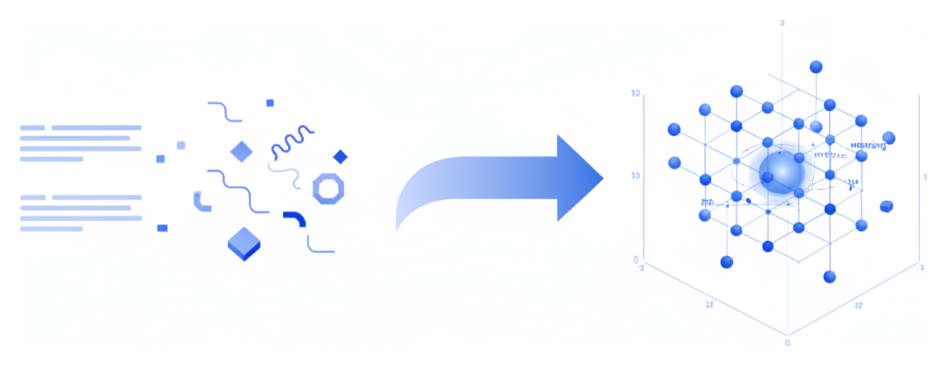
Think of semantic embeddings as a way to convert meaning into math. When you write a sentence like "the database connection timed out," an embedding model converts that text into a high-dimensional vector—typically 768 to 1536 numbers that represent the semantic content of that phrase.
The key insight is that similar meanings produce similar vectors. "Database connection failed" and "DB timeout error" would have vectors that are mathematically close to each other, even though they use different words. Meanwhile, "marketing campaign launched successfully" would be far away in vector space because it means something completely different.
This mathematical representation of meaning enables something powerful: you can search by concept rather than keyword. You don't need to guess what exact words someone used to describe a problem. You describe what you're looking for, convert that to a vector, and find everything semantically similar.
The Knowledge Base Architecture
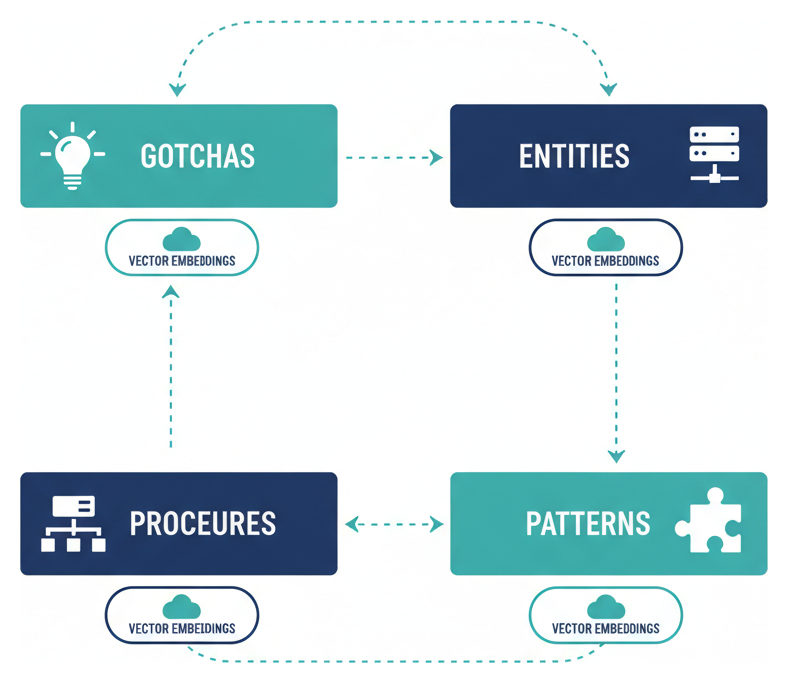
Our agent coordination system stores several types of organizational knowledge in vector-enabled tables:
- Gotchas — Hard-won lessons from past mistakes. When an agent encounters an issue, the system searches for similar problems that were solved before.
- Entities — Infrastructure knowledge: servers, services, databases, their relationships and configurations.
- Patterns — Reusable solution templates for common scenarios. When to use which approach, and why.
- Procedures — Step-by-step guides for complex operations that require specific sequences.
Each record in these tables has its core content plus an embedding vector. When we store a new gotcha like "Always check disk space before running large migrations," we also generate and store its embedding. Later, when an agent is about to run a migration and checks for relevant warnings, the semantic search finds this gotcha even if the agent's query uses completely different words.
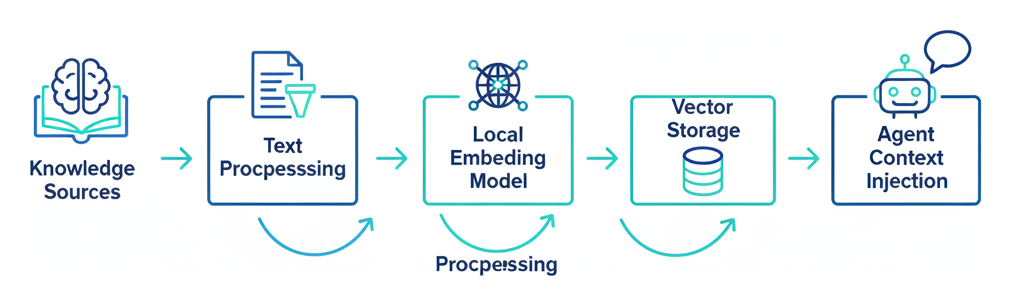
The embedding generation pipeline transforms knowledge into searchable vectors
Self-Hosted Embeddings: Why It Matters
A critical architectural decision we made early: all embedding generation happens on self-hosted infrastructure. We run local embedding models rather than calling external APIs.
This matters for several reasons:
Data sovereignty. Our knowledge base contains sensitive operational information—infrastructure details, incident postmortems, security configurations. Sending this data to external embedding services would be a security and compliance concern for many organizations.
Cost predictability. External embedding APIs charge per token. When you're embedding thousands of knowledge base entries and running frequent similarity searches, costs add up quickly. Self-hosted means fixed infrastructure costs regardless of usage volume.
Latency control. Agent coordination happens in real-time. Adding network round-trips to external services for every embedding lookup introduces latency that compounds across agent interactions.
Availability. External API outages don't affect your agent system's ability to access institutional knowledge.
Open-source embedding models have reached quality parity with commercial alternatives for most use cases. Models like those from the Nomic or Sentence Transformers families provide excellent semantic understanding while running entirely on your own hardware.
The Retrieval Pattern
When an agent starts working on a task, here's what happens behind the scenes:
1. Embed Context: The agent's current context (task description, relevant files, error messages) gets converted to an embedding vector.

2. Similarity Search: The system queries the knowledge base using vector similarity search, finding the most semantically related gotchas, patterns, and procedures.

3. Retrieve Matches: The top matches get injected into the agent's context before it begins work.
4. Informed Execution: The agent proceeds with awareness of relevant historical knowledge, without having been explicitly programmed with that information.
The beauty of this approach is that the agent doesn't need to know what to search for. The semantic layer surfaces relevant information based on conceptual similarity, catching connections that keyword search would miss.
"The agent working on a Kubernetes deployment issue automatically received context about a similar Docker Swarm problem from six months ago—because the underlying concepts were related, even though the specific technologies were different."
Batch Processing and Maintenance
Embeddings aren't generated in real-time for every query. Instead, we use batch processing to keep the knowledge base current:
- New knowledge entries are flagged for embedding generation
- Batch jobs periodically process unembedded records
- Each record tracks its embedding model version and generation timestamp
- Model upgrades trigger re-embedding of affected records
This approach balances freshness with efficiency. New critical gotchas can be prioritized for immediate embedding, while routine updates happen in scheduled batches.
The Multi-Agent Coordination Layer
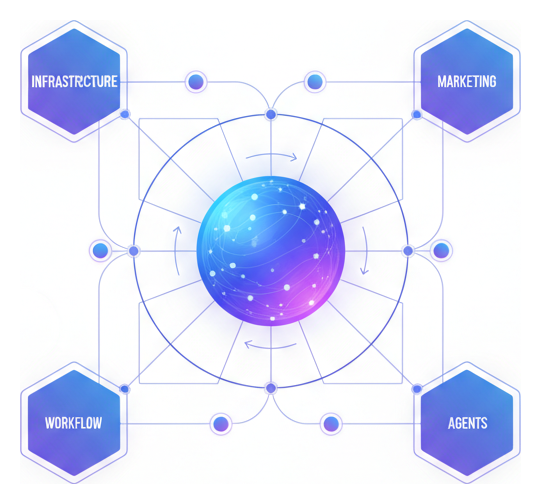
Where embeddings become truly powerful is in multi-agent coordination. When multiple specialized agents work together, semantic embeddings provide:
Cross-domain knowledge transfer. An agent working on infrastructure can benefit from a marketing agent's discovery about API rate limits—if the concepts are semantically related, the connection gets made automatically.
Session context retrieval. Agents can find relevant past sessions where similar problems were addressed, loading that context to avoid repeating mistakes or rediscovering solutions.
Skill discovery. When an agent needs a capability it doesn't have, semantic search over the skills registry can surface relevant procedures, even if the agent doesn't know the exact skill name.
Incident correlation. When something goes wrong, finding similar past incidents—based on semantic similarity of symptoms rather than keyword matching— dramatically accelerates diagnosis.
Implementation Considerations
If you're building similar systems, here are the key technical decisions we've found matter most:
Vector dimensions. We use 1536-dimensional vectors, which provide good semantic resolution without excessive storage or computation costs. Lower dimensions (384-768) work for simpler use cases; higher dimensions rarely provide proportional benefit.
Text preprocessing. What you embed matters as much as how you embed it. We concatenate multiple relevant fields (problem description + solution + category) to create richer semantic representations than any single field would provide.
Similarity thresholds. Not every "similar" result is relevant. We filter results by similarity score, only surfacing matches above a confidence threshold. This prevents low-quality matches from polluting agent context.
Result limits. More context isn't always better. We typically inject the top 3-5 most relevant matches, enough to provide useful background without overwhelming the agent's reasoning capacity.
Embedding model selection. Different models have different strengths. Technical documentation benefits from models trained on code and technical text. General business content works well with models trained on diverse web text. Match your model to your content.
The Business Impact
Beyond the technical elegance, semantic embeddings deliver concrete business value:
Reduced repeated mistakes. Every gotcha in the knowledge base is a mistake that won't be repeated. Semantic search ensures these lessons get surfaced when relevant, regardless of how the current problem is described.
Faster onboarding. New agents (or new team members working with agents) automatically benefit from accumulated organizational knowledge. The learning curve flattens because wisdom is embedded in the system, not trapped in individual heads.
Compound knowledge growth. Every solved problem, every documented pattern, every captured procedure makes the entire system smarter. Knowledge compounds rather than fragments.
Audit and compliance. The knowledge base provides a searchable record of decisions, solutions, and rationale. When regulators or auditors ask "why did you do X?" the answer is findable.
Looking Forward
Semantic embeddings are foundational to how we think about AI agent systems. As language models become more capable, the importance of high-quality context only increases. The agents themselves may get smarter, but they still need to know what your organization knows.
We're exploring several extensions to this architecture:
- Hybrid search — Combining vector similarity with traditional full-text search for cases where exact keyword matches matter alongside semantic similarity.
- Temporal weighting — Recent knowledge often matters more than old knowledge. Decay functions can prioritize freshness while still surfacing historically relevant content.
- Cross-organization knowledge — Anonymized, aggregated patterns that benefit from collective experience across multiple deployments.
- Embedding-based routing — Using semantic similarity to route tasks to the most qualified agent, not just by declared capabilities but by historical success with similar problems.
The organizations that invest in semantic infrastructure now will have compounding advantages as AI agents become more central to operations. The knowledge you capture today becomes the wisdom your agents leverage tomorrow.
"We stopped thinking of our knowledge base as documentation and started thinking of it as institutional memory that our agents can actually use. That shift changed everything about how we capture and organize information."
Ready to Build Intelligent Agent Infrastructure?
Let's discuss how semantic embeddings and AI agent coordination can transform your operations.
Schedule a Discovery Call